
Guide articles on plant nutrition, fertilization and soil health.
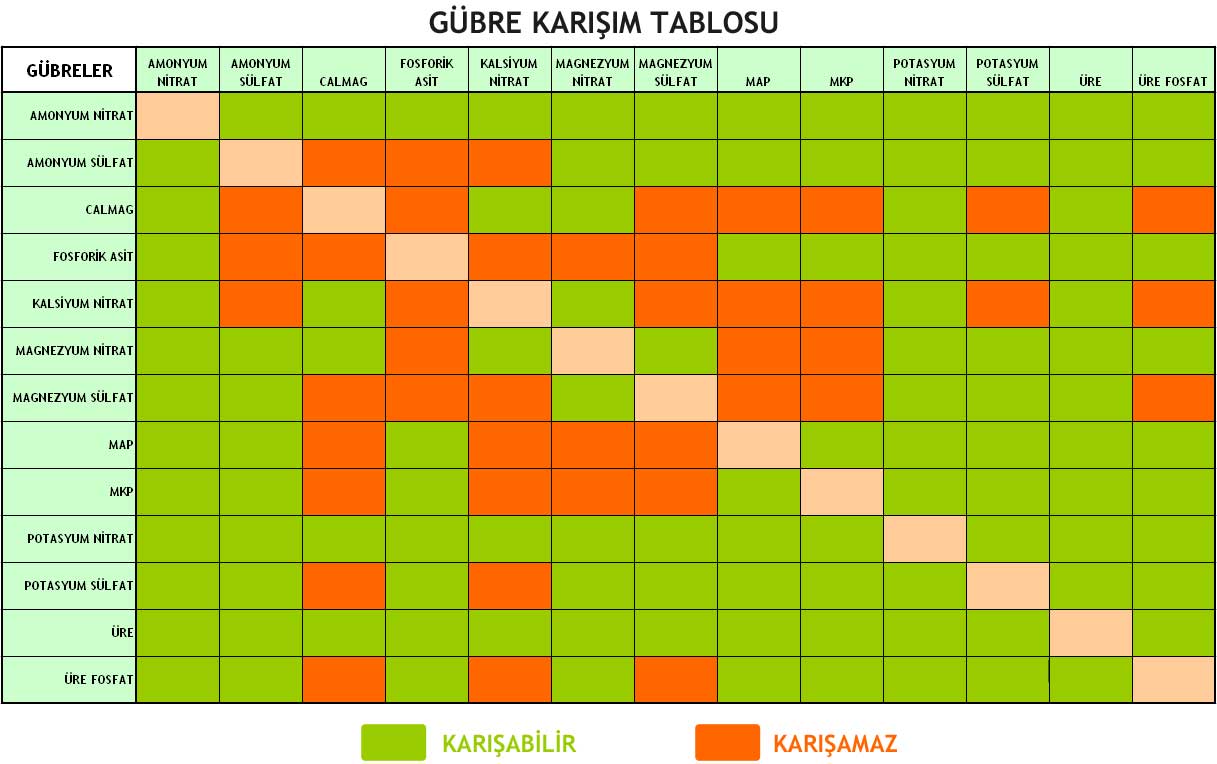 Fertilizer Miscibility Table
Read more →
Fertilizer Miscibility Table
Read more →
 NitrogenNitrogen: Among the nutrients, nitrogen deficiency is felt most quickly. That's why nitrogen is one of the most important plant nutrients…Read more →
 Copper (Cu)Copper (Cu) Generally, copper deficiency is not common due to the presence of copper in many medicines. However, in lands newly opened to agriculture…Read more →
 Boron (B)Boron (B) Boron is in the form of unionized boric acid (BHCO)3 in the soil. The limits of boron deficiency and toxicity are within a very narrow window...Read more →
 Zinc (Zn)Zinc (Zn) Our country's soils generally have high pH and lime content. Zinc is low in this and similar soils...Read more →
 Phosphorus (P)Phosphorus (P) Phosphorus in rocks, minerals and organic substances breaks down and becomes free, and the plant produces these free phosphorus compounds.Read more →
 Calcium (Ca)Calcium (Ca) Calcium is taken up by plants as Ca+2 ion through root tips. Calcium ions enter all plant tissues…Read more →
 Sulfur (S)Sulfur (S) The source of sulfur that can be absorbed by plants is elemental sulfur and sulfur found in organic matter. The plants roared…Read more →
 Magnesium (Mg)Magnesium (Mg) Plants absorb magnesium in the form of Mg+2 ion. Magnesium is the central atom of chlorophyll and is vital in photosynthesis.Read more →
 Manganese (Mn)Manganese (Mn) The factor that most affects manganese uptake is soil pH. Manganese uptake increases 100 times for one unit pH change.Read more →
 Molybdenum (Mo)Molybdenum (Mo) is found in very low amounts in the soil and the needs of plants are also very low. Plants convert Molybdenum into Molybdate ion (Mo-2)...Read more →
 Potassium (K)Potassium (K) Potassium does not enter the plant structure much like nitrogen and phosphorus. It mostly makes itself felt in some vital events of the plant...Read more →